
How Hyperautomation Works
Hyperautomation works by integrating multiple advanced technologies that interact with each other to automate tasks, analyze data, and optimize processes. The core idea is to create an ecosystem where software, data, and AI collaborate seamlessly.
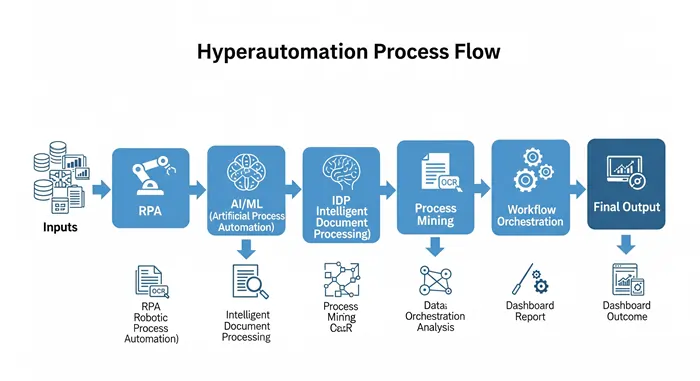
Below are the main components that power hyperautomation:
1. Robotic Process Automation (RPA)
RPA bots handle structured, rule-based tasks such as form filling, data entry, report generation, and system updates.
2. Artificial Intelligence (AI) and Machine Learning (ML)
AI and ML bring intelligence to automation. They can understand documents, classify information, analyze trends, and make predictions.
3. Process Mining
Process mining tools study business workflows, identify inefficiencies, and recommend the best areas for automation.
4. Intelligent Document Processing (IDP)
IDP uses AI and OCR to extract and understand data from invoices, forms, emails, images, and PDFs, reducing manual reading and verification.
5. Workflow Orchestration
Orchestration platforms connect all processes, tools, and systems, enabling smooth and coordinated end-to-end workflow automation.
6. Low-Code/No-Code Platforms
These platforms allow teams to build automation workflows easily without deep technical knowledge.
Key Components of Hyperautomation
These core building blocks work together to streamline workflows, boost efficiency, and scale automation across the entire business.
| Component | Purpose | Example Use Case |
|---|---|---|
| RPA | Automates rule-based tasks | Data entry, form filling |
| AI/ML | Adds intelligence & predictions | Fraud detection, forecasting |
| IDP | Understands documents | Invoice extraction |
| Process Mining | Shows workflow gaps | Identifying bottlenecks |
| Orchestration | Connects all processes | End-to-end automation |
Hyper Automation Benefits for Modern Enterprises
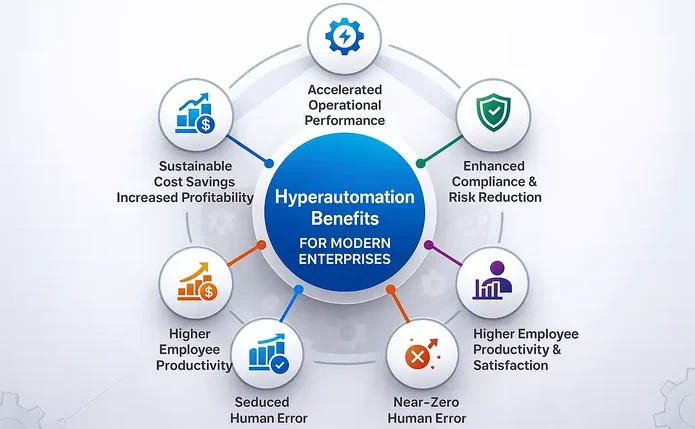
Businesses implementing hyperautomation experience measurable improvements in efficiency and accuracy. The top benefits include:
1. Faster Operational Output
Automated workflows deliver results faster than manual teams, reducing response time across departments.
2. Better Compliance and Governance
Automation keeps audit trails, ensures accuracy, and helps businesses meet regulatory standards.
3. Reduced Human Error
Automated systems execute tasks consistently, avoiding mistakes that often occur in manual processes.
4. Improved Employee Satisfaction
Employees can focus on strategic and creative tasks instead of repetitive work.
5. Increased Profitability
By reducing operational costs and optimizing workflows, businesses achieve long-term profitability.
Tools That Enable Hyperautomation
Below is a table showing the most popular tools and their key features.
| Tool Name | Core Features |
|---|---|
| UiPath | RPA automation, AI Center, Task Mining, Document Understanding, Workflow orchestration |
| Automation Anywhere | Cloud-native RPA, Bot Insights, IQ Bot (AI), process discovery, secure bot management |
| Blue Prism | Scalable enterprise RPA, digital workers, AI integration, strong security & governance |
| Microsoft Power Automate | Low-code automation, AI Builder, system connectors, workflow automation for Office ecosystem |
| IBM Cloud Pak for Automation | Intelligent automation, decision management, content management, operational insights |
| Appian | Low-code automation platform, case management, AI workflows, process modeling |
| Pega Systems | AI decisioning, RPA, low-code development, case management, workflow automation |