

NeuronWriter Explained: How This AI Tool Helps You Write SEO-Optimized Content Faster

Introduction

Creating SEO-optimized content is no longer just about writing long paragraphs or inserting keywords. Google now prioritizes semantic relevance, search intent, and topic authority. This is where NeuronWriter becomes a powerful asset for bloggers, content creators, SEO writers, and digital marketers.

NeuronWriter combines AI content writing, NLP-based competitor analysis, and topic optimization to help you craft content that ranks faster on Google. In this blog, you will understand what NeuronWriter is, why it is different from other AI tools, and how it helps you produce high-ranking SEO content efficiently.

What Is NeuronWriter?

NeuronWriter is an AI-powered SEO writing and optimization platform designed to help you plan, research, structure, and write content based on how Google understands topics. It uses Natural Language Processing (NLP) and SERP data to show you:

  • What top-ranking competitors are writing

  • What keywords and entities they use

  • Content gaps you can fill

  • Structure recommendations

  • Real-time content score to check your optimization

Key Features of NeuronWriter

1. Competitor Research Based on SERP Analysis

NeuronWriter analyzes the top-ranking pages for your chosen keyword. It breaks down:

  • Their headings

  • Word count

  • Keywords used

  • Entities

  • Sentiment

  • Search intent

This helps you understand exactly what works in your niche.


2. AI Content Writer

NeuronWriter includes advanced AI writing capabilities that help you:

  • Generate SEO-optimized paragraphs

  • Create outlines and subheadings

  • Expand, rewrite, or summarize content

  • Maintain a natural, human-like flow

It is especially useful when you want to speed up drafting without compromising quality.


3. Content Scoring & Optimization

The tool gives every article a real-time score based on:

  • Keyword usage

  • Content length

  • Semantic coverage

  • Competitor benchmarks

The higher your score, the more likely your content will rank.


4. Topic Suggestions & NLP Keywords

NeuronWriter recommends:

  • Primary keywords

  • Secondary keywords

  • Related phrases

  • Entities from NLP

These suggestions help you write content that covers the topic in depth, not just superficially.


5. Content Planning & Organization

You can create content projects, save drafts, and track your optimization progress. This makes NeuronWriter ideal for:

  • Bloggers

  • Agencies

  • Freelancers

  • SEO teams

Everything stays organized inside one workspace.

🔥 Get Started with NeuronWriter

Create high-ranking content faster using AI and real SEO data. Start your journey now.

Example: How NeuronWriter Analyzes Your Content

1. Competitor Benchmark Analysis

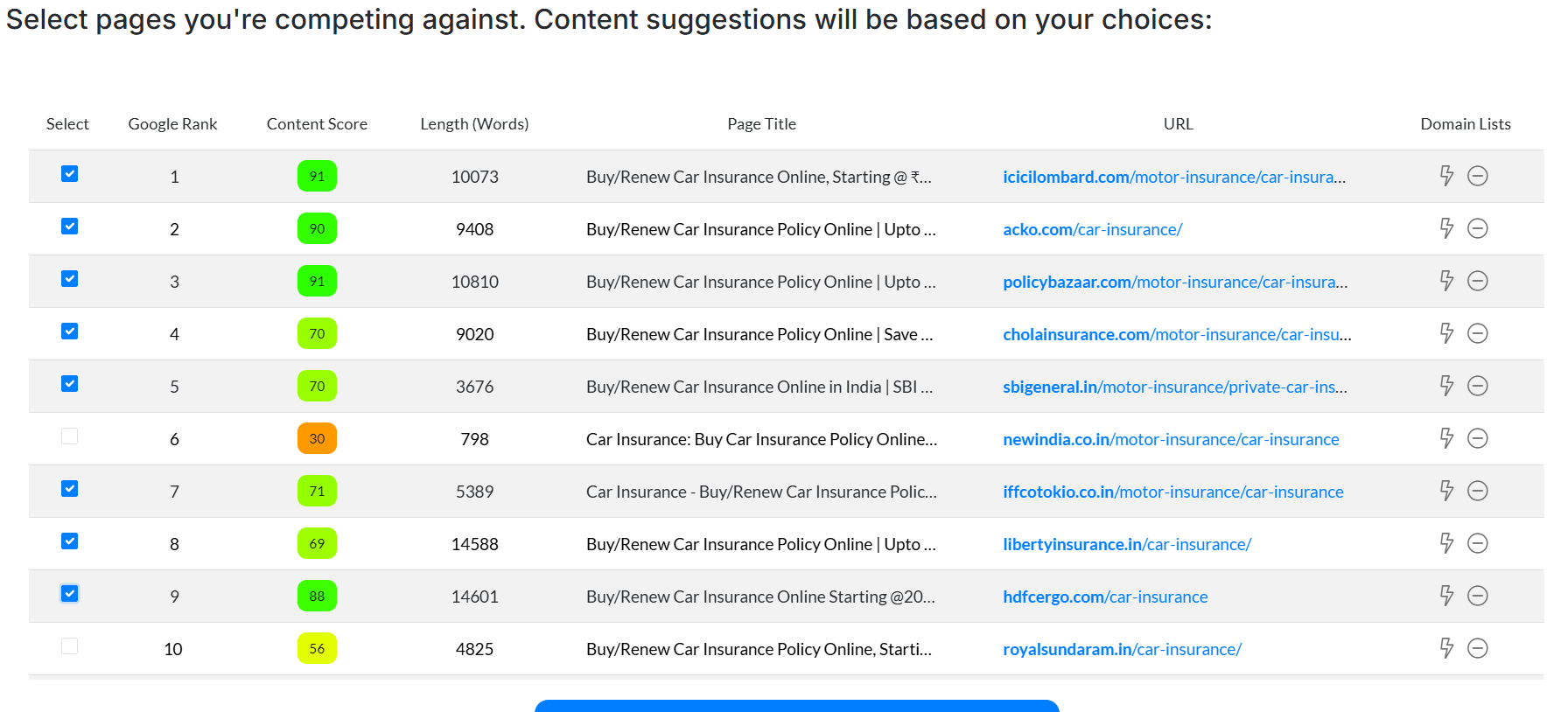
When you enter a keyword, NeuronWriter instantly scans the Google SERP and pulls data from the top-ranking pages.
For our keyword “car insurance,” here is what the tool shows:
neuron_ss_1

NeuronWriter then calculates the competitor average, giving us a target:

  • Average Target Word Count: 9,214 words

  • Average Target Score: ~70+

This tells us that the top-performing articles in this niche are extremely detailed and long.
To compete, our content must match the depth, structure, and semantic coverage of these pages.

2. Real-Time Analysis of Your Draft

After entering our title “Car Insurance” and the H1 heading “Car Insurance: Understanding Your Car Insurance Policy Online,” NeuronWriter evaluates the draft instantly.neuron_ss_2
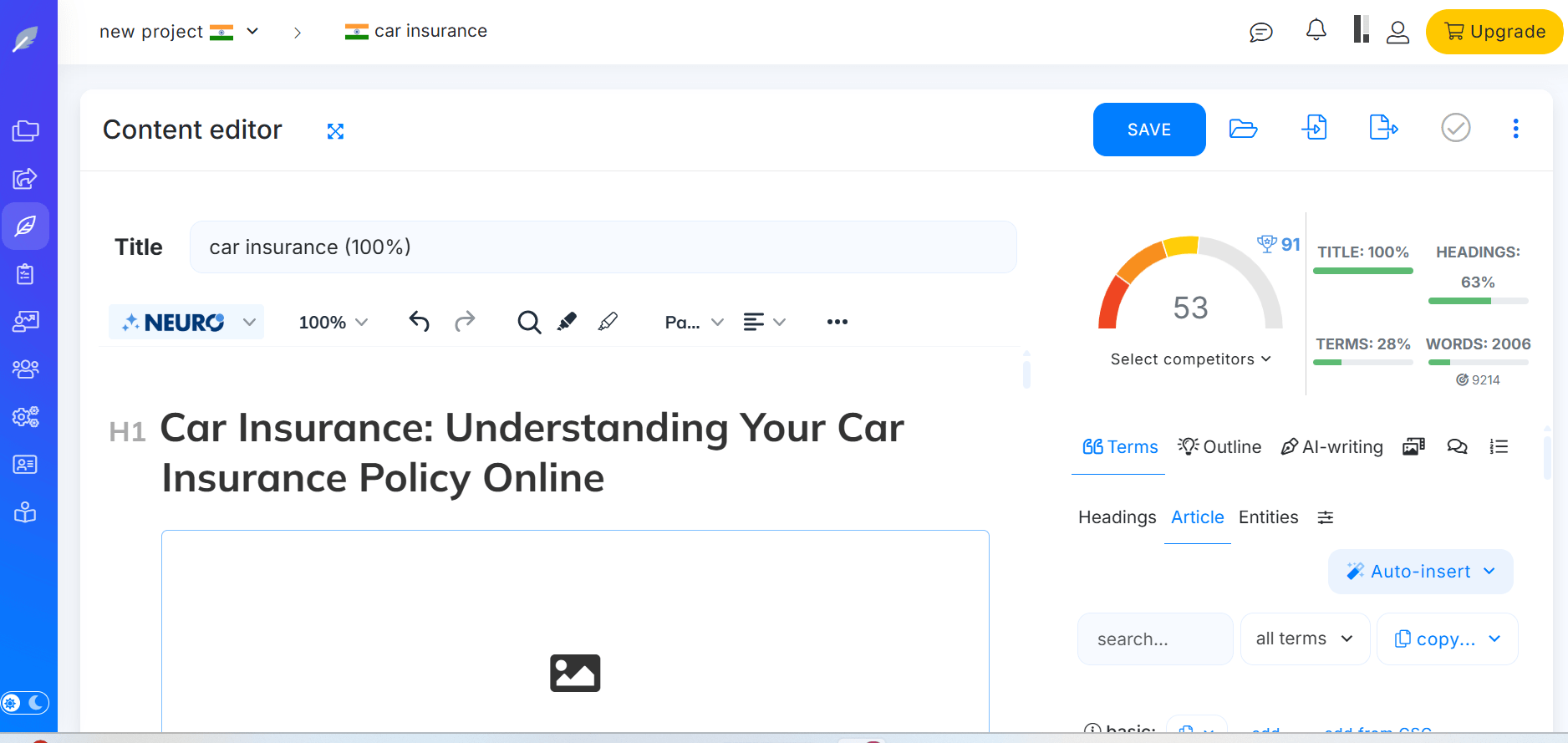
NeuronWriter highlights the areas needing attention using the right-side panel (Terms, Headings, Competitors, etc.).
This allows you to update your draft scientifically, not by guesswork.

3. Key Takeaways from This Example

This example shows exactly how NeuronWriter guides you through SEO optimization:

A. Content Length Needs Major Improvement

Your draft has 2,006 words, but the competitor benchmark is 9,214 words.
To compete, you must increase the content length by 4x or more.

B. Add More Semantic Keywords (NLP Terms)

The Terms score is just 28%.
To improve it, you should incorporate relevant entities naturally, such as:

  • deductible

  • premium

  • policy limits

  • coverage types

  • liability insurance

  • claim filing process

Using these terms boosts both the content score and Google’s understanding of your topical depth.

C. Optimize Your Headings

With a 63% heading score, you need to adjust your H2 and H3 tags by:

  • Adding suggested keywords

  • Improving topical alignment

  • Matching competitor intent and structure

 

🔥 Get Started with NeuronWriter

Create high-ranking content faster using AI and real SEO data. Start your journey now.

FAQ’s

1. What is NeuronWriter and how does it help with SEO content creation?

NeuronWriter is an AI-powered content optimization tool that analyzes top-ranking pages on Google and provides data-driven recommendations for improving your content. It helps you plan, structure, and write SEO-focused articles by showing you the keywords, topics, and headings your competitors are using. This allows you to create content that matches search intent and has a higher chance of ranking on the first page.

NeuronWriter scans the Google SERP for your chosen keyword and evaluates every competitor’s content score, word count, headings, and usage of semantic terms. It then compares your draft side-by-side with these metrics in real time. This shows you exactly what is missing, such as low word count, incomplete headings, or insufficient keyword coverage, helping you optimize strategically.

Yes. NeuronWriter includes an AI writing assistant that generates paragraphs, expands text, rewrites content, and provides suggestions based on your topic and SERP data. The AI ensures your writing stays natural, coherent, and aligned with SEO requirements, making the writing process faster and more efficient.

Yes. NeuronWriter encourages natural keyword usage by showing recommended frequencies rather than forcing repetitions. If you overuse a term, it highlights it so you can adjust. This ensures your article stays reader-friendly and avoids Google penalties related to keyword stuffing.